

A free SMS API allows developers to send and receive text messages programmatically without upfront costs. Popular providers like Twilio, Vonage, and Sinch offer free trial credits, REST APIs, and easy integration options. Choosing the right free SMS API depends on factors like pricing, global coverage, scalability, and messaging features.
A free SMS API lets developers send text messages programmatically without upfront costs. The best free SMS API services include Twilio, Vonage, and Sinch—each offering trial credits, REST-based endpoints, and straightforward integration. This guide covers how each platform works, what to look for, and how to get started.
Sending a text message from an app sounds simple. But building the infrastructure to do it reliably, at scale, and across multiple carriers? That’s a different challenge entirely.
That’s where SMS APIs come in. An SMS API (Application Programming Interface) connects your application to a cloud-based messaging network, allowing you to send, receive, and manage text messages programmatically. No hardware. No telecom contracts. Just a few lines of code.
For developers, startups, and small businesses, the question isn’t just which SMS API to use—it’s which one offers a free tier that’s actually useful. Many providers advertise “free” plans that quickly hit walls. Others offer trial credits that expire before you’ve finished testing.
This guide breaks down everything you need to know: what a free SMS API is, how SMS gateway APIs work, the top platforms worth trying, and how to integrate one into your project today.
What Is a Free SMS API and How Does It Work?

A free SMS API is a cloud-based interface that allows developers to send and receive text messages without paying upfront. Most providers offer free tiers or trial credits—enough to test core features before committing to a paid plan.
Under the hood, an SMS API connects your application to an SMS gateway. The gateway acts as a bridge between the internet and the global mobile network (PSTN), translating your API request into a signal that reaches a phone number anywhere in the world.
Here’s the basic flow:
- Your application sends an HTTP request to the SMS API endpoint
- The API authenticates the request using your API key
- The SMS gateway routes the message to the recipient’s carrier
- The carrier delivers the message to the recipient’s device
- A delivery receipt (webhook) is returned to your application
Most modern SMS APIs are REST-based, meaning they use standard HTTP methods (GET, POST) and return responses in JSON format. This makes them easy to integrate with virtually any programming language—Python, Node.js, Ruby, PHP, Java, and more.
What Should Developers Look for in an SMS Gateway API?
Not all free SMS API services are created equal. Before committing to a platform, evaluate these criteria:
Free tier limitations: How many messages can you send for free? Is there a time limit on trial credits? Some platforms offer 10 free messages per day; others offer $10–$15 in credits to use however you like.
REST API quality: Look for well-documented REST SMS API endpoints, clear error codes, and reliable uptime. A poorly documented API will cost you hours of debugging.
Global reach: Does the text messaging API support the countries your users are in? Coverage varies significantly between providers.
Scalability: Can the platform handle bulk SMS API requests when your user base grows? Check rate limits on free tiers.
Webhooks and inbound SMS: Can you receive messages, not just send them? Two-way messaging is essential for verification flows, chatbots, and customer support.
SDKs and libraries: Does the provider offer official SDKs, or will you be writing raw HTTP requests from scratch?
The Top Free SMS API Services Worth Trying

Twilio — Best Overall Free SMS API for Developers
Twilio is the most widely used cloud SMS API in the world. The Twilio free trial gives new users a $15.50 credit—enough to send roughly 200–300 SMS messages, depending on destination country.
What makes Twilio stand out:
- Comprehensive REST SMS API with extensive documentation
- Official SDKs for Python, Node.js, Java, C#, Ruby, PHP, and Go
- Programmable SMS, MMS, and WhatsApp messaging from a single platform
- Webhooks for inbound SMS and delivery status callbacks
- Twilio Studio for building no-code messaging workflows
The free trial does come with a caveat: messages sent from a trial account include a prefix (“Sent from a Twilio trial account”), and you can only send to verified phone numbers. Upgrading removes both restrictions.
Twilio’s pricing after the trial starts at approximately $0.0079 per message (US), making it competitive for bulk SMS API use cases.
Vonage (formerly Nexmo) — Best Free SMS API for Global Reach
Vonage provides $2 in free credit upon signup—modest, but enough to test the SMS API integration flow. The real advantage of Vonage is its global network coverage, which spans over 200 countries.
Key features:
- Simple REST-based text messaging API
- Delivery receipts and inbound SMS via webhooks
- Number masking and virtual number support
- Vonage Messages API supports SMS, MMS, WhatsApp, and Viber from one integration
Vonage’s documentation is clean and well-organized, making it a solid choice for developers new to SMS API integration.
Sinch — Best Free SMS API for Verification Use Cases
Sinch focuses on customer communications, with a particularly strong offering for OTP (one-time password) and verification SMS flows. New accounts receive free trial credits to test core features.
Key features:
- Sinch SMS API supports REST and SMPP protocols
- Built-in verification API for two-factor authentication (2FA)
- Flash SMS and long-form messaging support
- Strong bulk SMS API performance with high throughput rates
If you’re building an app that needs phone number verification, Sinch’s dedicated verification product is worth evaluating alongside its core SMS API.
TextBelt — Best Lightweight Free SMS API for Simple Projects
TextBelt is a no-frills SMS API designed for developers who need something fast and simple. The free tier allows one SMS per day using the endpoint textbelt.com/text—genuinely free, with no account or API key required for basic use.
When to use TextBelt:
- Personal projects and prototyping
- Internal tools with low message volumes
- Situations where a heavyweight SDK would be overkill
TextBelt’s simplicity is its strength. A single POST request is all it takes to send a message. However, the one-message-per-day limit makes it unsuitable for production environments.
How to Send SMS via API: A Step-by-Step Integration Guide
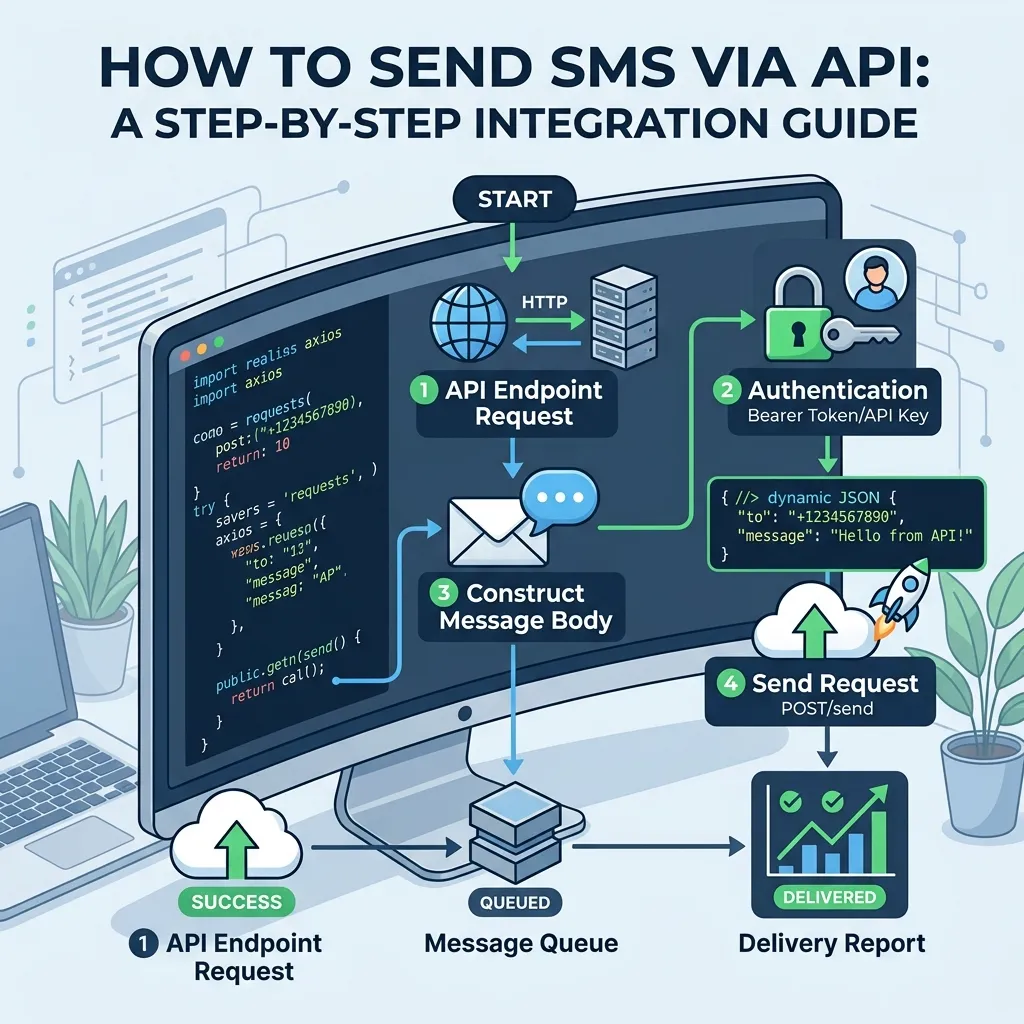
Here’s a practical walkthrough of SMS API integration using Twilio’s REST SMS API and Python:
Step 1: Sign up and get your credentials
Create a free account at twilio.com. After verifying your email and phone number, you’ll find your Account SID and Auth Token in the Twilio Console.
Step 2: Install the SDK
pip install twilio
Step 3: Send your first message
from twilio.rest import Client

account_sid = "your_account_sid"
auth_token = "your_auth_token"
client = Client(account_sid, auth_token)

message = client.messages.create(
    body="Hello from your SMS API!",
    from_="+1234567890",  # Your Twilio number
    to="+0987654321"      # Recipient's number
)

print(message.sid)
That’s it. Three imports, one function call, and your message is on its way through the cloud SMS API to the recipient’s phone.
The same pattern applies to other providers. The specific SDK and endpoint will differ, but the core flow—authenticate, construct the request, call the API—remains consistent across all major SMS gateway API providers.
How to Use a Bulk SMS API Effectively
Sending one message is easy. Sending 10,000 messages reliably requires a different approach.
When working with bulk SMS API requests, keep these principles in mind:
Respect rate limits: Most free and entry-level plans cap throughput at 1–10 messages per second. Exceeding this triggers rate limit errors. Use queuing systems (like Redis or RabbitMQ) to manage high-volume sends.
Use message templates: Pre-approved templates reduce the risk of messages being flagged as spam by carriers, especially for marketing campaigns.
Handle delivery receipts: Don’t assume a message was delivered because the API returned a 200 response. Always implement webhook handlers to track actual delivery status.
Segment your audience: Sending irrelevant messages increases opt-out rates and harms long-term deliverability. Most cloud SMS API providers track complaint rates and may suspend accounts with high opt-outs.
Honor opt-outs immediately: In most jurisdictions, including the US (TCPA), Canada (CASL), and the EU (GDPR), you are legally required to stop messaging users who reply “STOP.” Ensure your integration handles inbound SMS and updates your contact list accordingly.
What Are the Limitations of Free SMS API Plans?
Free SMS API tiers are excellent for testing and small-scale use, but they come with real constraints:
Message volume caps: Free tiers typically limit you to 10–300 messages total, or a daily cap that prevents production use.
Sender ID restrictions: Free accounts often require you to send from a shared number or a pool of numbers, which can harm brand recognition.
Trial message disclaimers: Some providers (like Twilio) prepend a trial notice to all messages sent from free accounts.
Geographic restrictions: Certain countries may be excluded from free tiers due to carrier costs.
No dedicated support: Free plan users typically rely on community forums and documentation rather than dedicated support channels.
For production applications, expect to graduate to a paid plan. Most providers offer pay-as-you-go pricing, which keeps costs low while removing free tier restrictions.
Choosing the Right Free SMS API: A Practical Comparison
|
Provider |
Free Credits |
REST API |
Bulk SMS |
Global Reach |
Best For |
|---|---|---|---|---|---|
|
Twilio |
$15.50 |
✅ |
✅ |
180+ countries |
General-purpose development |
|
Vonage |
$2.00 |
✅ |
✅ |
200+ countries |
Global reach |
|
Sinch |
Trial credits |
✅ |
✅ |
160+ countries |
Verification/2FA |
|
TextBelt |
1 msg/day |
✅ |
❌ |
US-focused |
Lightweight projects |
Choose Twilio if you need the most generous free trial and the most comprehensive developer experience. Choose Vonage if your users are spread across many countries. Choose Sinch if verification SMS is your primary use case. Choose TextBelt if you need something that works in minutes with no account setup.
Building a Reliable SMS Integration: Best Practices
Before shipping your SMS API integration to production, run through this checklist:
- Store API keys securely: Never hardcode credentials. Use environment variables or a secrets manager.
- Implement retry logic: Network failures happen. Build in exponential backoff for failed requests.
- Log all outbound messages: Track message SIDs so you can trace delivery issues.
- Test across carriers: A message that delivers fine on Verizon may behave differently on T-Mobile. Test with multiple numbers.
- Monitor delivery rates: Set up alerts if your delivery rate drops below 95%. Sudden drops often indicate content filtering or number blocklisting.
- Plan for scale early: Choose a cloud SMS API provider whose pricing and rate limits can grow with your user base.
Start Sending: Your Next Steps with a Free SMS API
A free SMS API removes the biggest barrier to building text messaging into your application—getting started. The infrastructure is already built. The documentation is available. The trial credits are waiting.
The most important step is simply picking a provider and sending your first message. Twilio’s free trial offers the most headroom for exploration. Vonage is a strong alternative if global reach matters from day one. For quick prototypes, TextBelt gets you to “Hello World” in under five minutes.
Once you’ve tested locally, focus on the fundamentals: secure credential storage, delivery tracking, opt-out handling, and rate limit management. Get those right, and you’ll have an SMS integration that’s ready for real users—not just a demo.
The best time to start building is now. Pick your provider, grab your API key, and send your first message.
Frequently Asked Questions
What is the best free SMS API for developers?
Twilio offers the most developer-friendly free SMS API experience, with $15.50 in trial credits, official SDKs for all major languages, and comprehensive documentation. Vonage is the best alternative for projects requiring broad international coverage.
Can I send bulk SMS for free using an API?
Most free SMS API tiers impose strict message volume caps that make bulk sending impractical. Twilio’s trial credits can cover small batches for testing, but bulk SMS API use cases typically require a paid plan with higher rate limits.
What is an SMS gateway API?
An SMS gateway API is a cloud-based service that connects your application to the global mobile carrier network. When you send a request to the API, the SMS gateway translates it into a message that gets routed through carrier infrastructure to reach the recipient’s phone.
How do I integrate an SMS API into my app?
SMS API integration typically involves three steps: sign up for a provider account, install the official SDK or configure raw HTTP requests, and call the send message endpoint with your API key, sender number, recipient number, and message body. Most providers can be integrated in under 30 minutes.
Are free SMS APIs reliable enough for production use?
Free SMS API tiers are suitable for testing and prototyping, but most include restrictions—such as message disclaimers, volume caps, or unverified recipient requirements—that make them unsuitable for production. Upgrade to a paid plan before launching to real users.
What is the difference between a REST SMS API and SMPP?
A REST SMS API communicates over standard HTTPS using JSON, making it accessible to any developer without specialized knowledge. SMPP (Short Message Peer-to-Peer) is a lower-level binary protocol used by enterprises that require very high throughput. For most applications, a REST SMS API is the right choice.
Is it legal to send bulk SMS messages?
Bulk SMS is legal in most countries but subject to strict regulations. In the US, the Telephone Consumer Protection Act (TCPA) requires prior written consent before sending marketing messages. The EU’s GDPR imposes similar requirements. Always obtain explicit opt-in consent and provide a clear opt-out mechanism before sending bulk messages.
