

SMS open rates are among the highest of any marketing channel, making SMS a powerful way to reach customers quickly. By sending timely, personalized messages with clear calls-to-action and tracking key metrics, businesses can improve engagement, increase conversions, and maximize the success of every SMS campaign.
SMS marketing consistently outperforms email with average open rates of 98%, response rates around 45%, and click-through rates between 6–19%. These numbers make SMS one of the highest-performing channels in modern mobile marketing. The key to sustaining those results lies in timing, personalization, and list hygiene.
Pull up your phone and count how many unread text messages you have. Probably not many. Now check your email. Most people have hundreds—sometimes thousands—sitting unopened.
That gap tells you everything you need to know about SMS marketing.
Text messages get read. Fast. Most are opened within three minutes of delivery, according to research from EZTexting. Compare that to email, where the average open rate hovers around 20–25%, and it becomes clear why brands across retail, healthcare, and e-commerce are shifting budget toward SMS campaigns.
But raw open rates only tell part of the story. To build a high-performing SMS strategy, marketers need to understand the full picture: response rates, click-through rates, conversion benchmarks, and the practices that separate campaigns that convert from those that get ignored—or worse, flagged as spam.
This guide breaks down the most important SMS marketing statistics and what they mean for your campaigns.
What Is the Average SMS Open Rates?
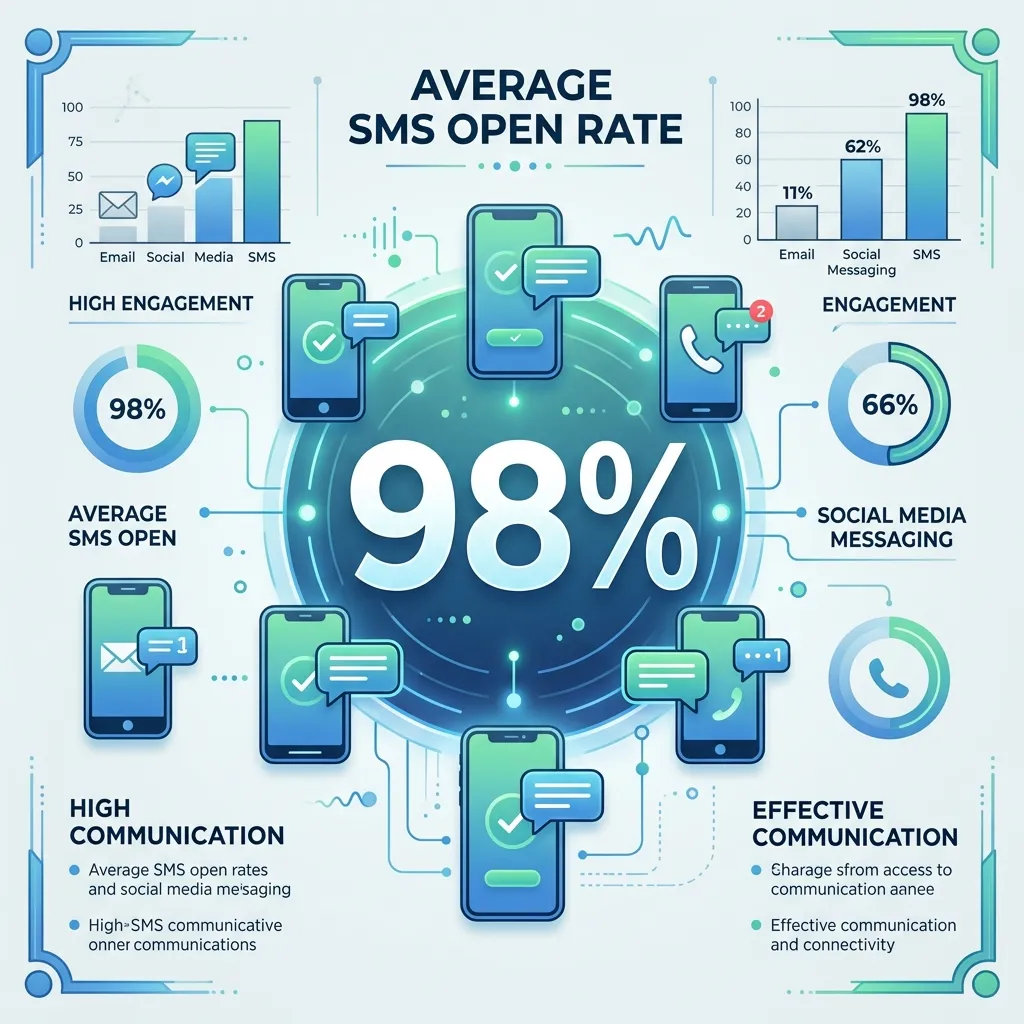
The average SMS open rate sits at approximately 98%, making it the highest of any marketing channel. That figure comes up repeatedly across studies from Gartner, EZTexting, and SimpleTexting, and while methodologies vary slightly, the consensus is consistent: people open texts.
For context, here’s how SMS stacks up against other channels:
- Email open rate: 20–25% (Mailchimp, 2023)
- Push notification open rate: 5–15%
- SMS open rate: 95–98%
The reason isn’t complicated. Texts arrive in a dedicated inbox with no algorithmic filtering, no promotional tab, and no spam folder. They vibrate the phone, flash the lock screen, and sit there demanding attention. Most people simply can’t leave a text unread.
That said, a 98% open rate doesn’t guarantee results. An opened message that doesn’t drive action is still a missed opportunity. That’s where response rates and click-through rates come in.
What Are Typical SMS Marketing Response Rates?
The average SMS response rate is approximately 45%, compared to just 6% for email, according to data from SMS Comparison. That’s a significant gap, and it reflects a fundamental difference in how people relate to their inboxes.
Email inboxes are increasingly associated with work, spam, and marketing. Text messages still carry the social weight of personal communication. When a message lands in that space—and it’s relevant, timely, and clear—people respond.
Response rates vary by industry and use case:
- Appointment reminders: Often exceed 50% response
- Promotional offers with a clear deadline: 30–45%
- Two-way conversational SMS: Can reach 60%+ when personalized
The takeaway? SMS isn’t just a broadcast channel. Campaigns that invite a reply—whether to confirm an appointment, claim an offer, or answer a simple question—consistently outperform one-way blasts.
What Is the SMS Click-Through Rate (CTR) Benchmark?
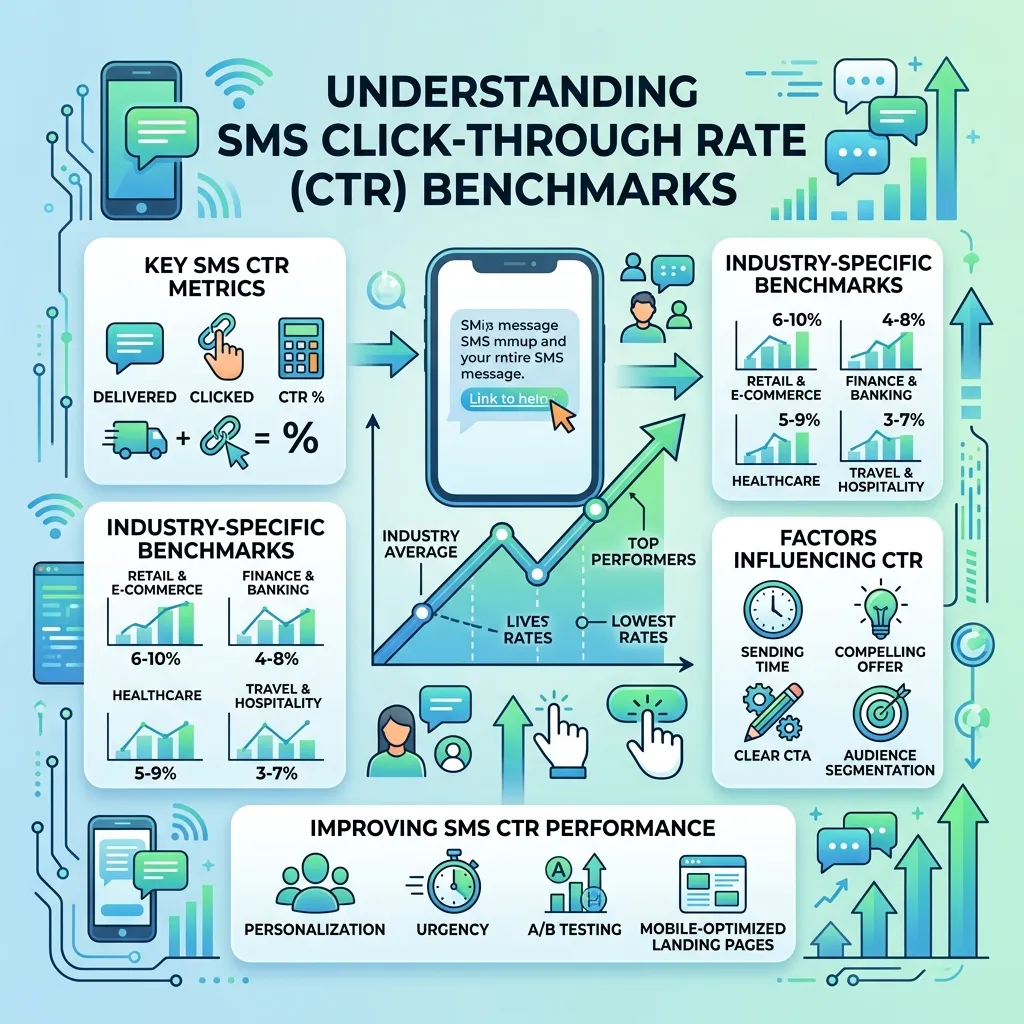
SMS click-through rates range from 6% to 19%, depending on the industry, offer, and quality of the call-to-action. Attentive’s 2023 SMS benchmark report places average CTR for promotional texts at around 8–10%, while highly targeted campaigns with personalized offers push closer to the upper end of that range.
Compare that to email CTR, which averages around 2–3% (Campaign Monitor, 2023). Even on a conservative basis, SMS CTR outperforms email by a factor of three or more.
A few factors that drive higher SMS click-through rates:
- Short, direct links: Long URLs get ignored. Use branded or shortened links.
- Urgency: Limited-time offers consistently outperform open-ended ones.
- Personalization: Including the recipient’s name or referencing past behavior improves CTR.
- Single CTA: Messages with one clear action outperform those with multiple options.
SMS Conversion Rates: What Results Can You Expect?
Conversion rates for SMS marketing typically fall between 1% and 10%, with higher figures reserved for well-segmented lists and time-sensitive promotions. For e-commerce brands, abandoned cart SMS messages are among the strongest performers—some report conversion rates above 10% when messages are sent within the first hour of cart abandonment.
The variables that influence SMS conversion rates include:
- List quality: A smaller, opted-in list will almost always outperform a large, cold one
- Timing: Messages sent at optimal times (typically mid-morning or early evening on weekdays) see better results
- Offer relevance: Generic promotions convert far below personalized ones
- Funnel stage: SMS works particularly well for warm audiences already familiar with the brand
SMS is rarely the only touchpoint in a conversion path. High-performing brands use SMS alongside email and retargeting to create multiple moments of engagement before a purchase decision is made.
SMS Marketing Statistics Worth Bookmarking
Here’s a consolidated reference of key SMS marketing statistics drawn from published industry research:
- 98% average SMS open rate (Gartner)
- 90 seconds average time to respond to a text vs. 90 minutes for email (CTIA)
- 45% average SMS response rate (SMS Comparison)
- 6–19% SMS click-through rate range (Attentive, 2023)
- 75% of consumers say they’re comfortable receiving SMS messages from brands they’ve opted in to (EZTexting)
- 56% of people would rather receive brand communications by text than any other channel (Zipwhip)
- 33% of consumers respond to brand texts (GSMA)
- 10x higher CTR than email in some verticals (Klaviyo)
These numbers represent averages and benchmarks. Actual performance will vary based on industry, audience, and execution. But as a baseline, they illustrate why SMS marketing gets serious attention from performance-focused teams.
SMS Marketing Best Practices That Improve Campaign Performance
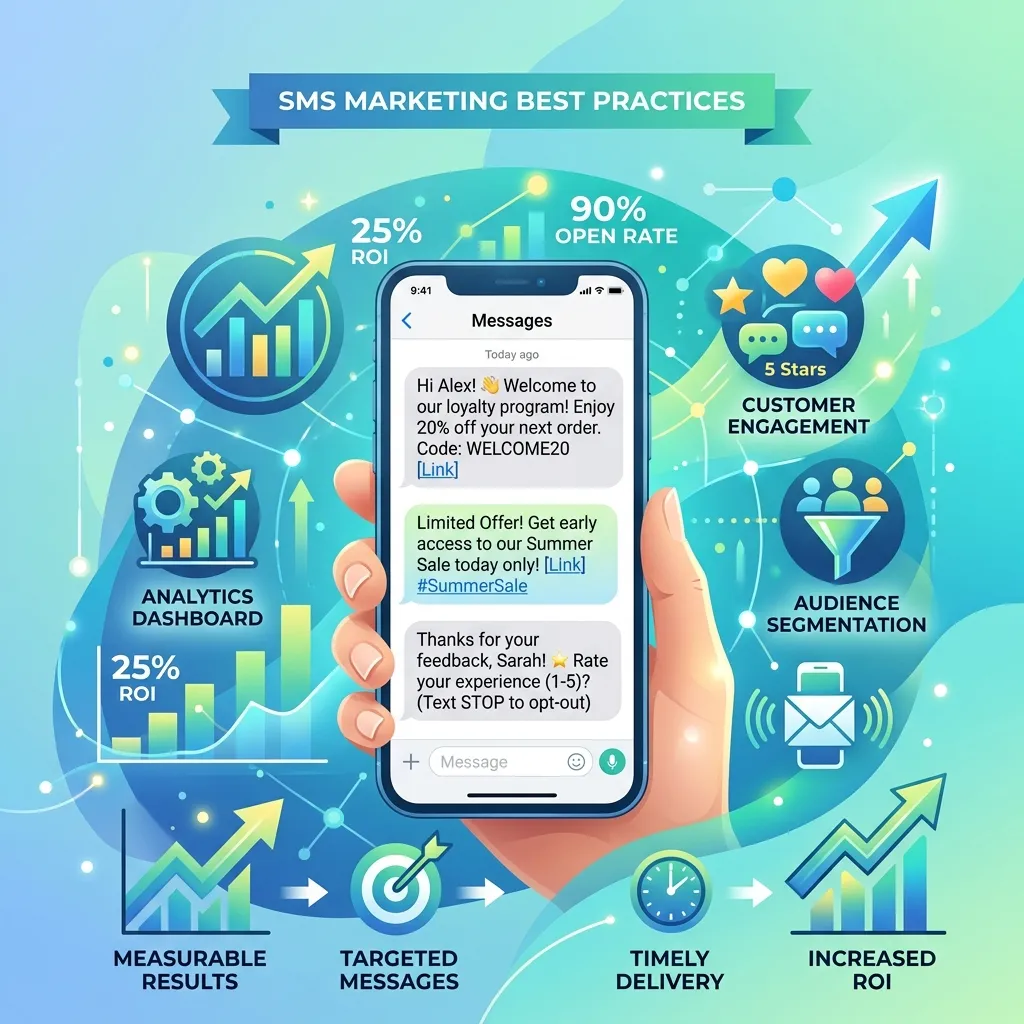
Strong statistics are only the starting point. The brands that sustain those numbers over time follow a set of practices that protect list quality, maintain trust, and continuously improve messaging.
How can I increase my SMS open and response rates?
Segment your audience. One of the most reliable ways to increase SMS engagement is to stop sending the same message to everyone. Segmenting by behavior, purchase history, location, or lifecycle stage means each subscriber receives messages that are actually relevant to them. Relevance drives opens, responses, and conversions.
Get the timing right. Sending a promotional text at 11 PM is a fast track to opt-outs. Research from Klaviyo suggests that mid-morning (10–11 AM) and early evening (6–8 PM) on weekdays are the strongest windows for SMS engagement. Test across time zones if your audience is geographically spread.
Keep messages concise. SMS is not the place for lengthy copy. A well-performing text typically includes one key offer or piece of information, one clear call-to-action, and a link—nothing more. Brevity respects the channel.
Use personalization. Including a subscriber’s name in the opening line has been shown to lift click-through rates. Referencing specific products they’ve browsed or purchased goes even further. Most modern SMS platforms support dynamic fields that make this straightforward to implement.
Always include an opt-out option. Beyond being a legal requirement in most markets, a clear opt-out actually improves list quality. Subscribers who don’t want your messages shouldn’t be on your list. A cleaner list delivers higher engagement rates across every metric.
What are the most common reasons SMS campaigns underperform?
- Sending too frequently: Fatigue sets in quickly. Most audiences respond well to two to four messages per month; above that, opt-out rates climb.
- Lack of clear CTA: “Check it out” is not a CTA. “Claim 20% off before midnight” is.
- Generic messaging: Blasting the same offer to every subscriber treats your audience as one homogeneous group.
- Ignoring compliance: TCPA in the US, GDPR in Europe, and similar regulations require explicit consent. Non-compliant campaigns face fines and platform bans.
How does SMS compare to email for mobile marketing engagement?
SMS and email serve different roles and work best together. Email excels at longer-form storytelling, nurture sequences, and content-rich campaigns. SMS is built for urgency, immediacy, and high-priority messages that need to be seen and acted on quickly.
Brands that use both channels strategically—sending an email with full campaign details and an SMS for the final-day reminder—consistently outperform those using either channel in isolation.
The Future of SMS Marketing Performance
Mobile marketing engagement is trending upward across the board. RCS (Rich Communication Services) is expanding what’s possible within the SMS channel—allowing brands to send images, carousels, and interactive buttons without pushing subscribers to a separate app. As RCS adoption grows, the gap between SMS and in-app messaging will narrow, and engagement benchmarks will likely shift upward.
AI-powered personalization is also reshaping how SMS campaigns are built. Predictive send-time optimization, dynamic content, and automated conversational flows are already available in platforms like Attentive and Klaviyo, enabling brands to move beyond batch-and-blast toward genuinely responsive messaging.
Is SMS Marketing Worth It for Your Business?
The data makes a strong case. A 98% open rate, a 45% response rate, and click-through rates that consistently outperform email are difficult to dismiss. But numbers alone don’t determine whether SMS is right for your business.
Choose SMS marketing if your audience is mobile-first, your offers are time-sensitive, or you’re looking for a direct channel with minimal algorithmic interference. Prioritize email if your content is long-form, your sales cycle is long, or your audience skews toward older demographics less accustomed to brand texts.
For most brands, the question isn’t whether to use SMS—it’s how to use it well. Start with a clean, opted-in list. Segment from day one. Test timing and messaging rigorously. And treat every text as a conversation, not a broadcast.
The open rate will take care of itself.
Frequently Asked Questions
What is a good open rate for SMS marketing?
Any rate above 90% is considered strong for SMS marketing. The channel average sits at 95–98%, driven by the immediacy of text notifications. If your open rates fall significantly below 90%, list quality or sending frequency are usually the first things to investigate.
How does SMS response rate compare to email?
SMS response rates average around 45%, compared to roughly 6% for email. The difference reflects the more personal, immediate nature of text messaging versus the often-cluttered email inbox.
What click-through rate should I expect from SMS campaigns?
Typical SMS click-through rates range from 6% to 19%. Promotional campaigns with strong personalization and urgency tend to land at the higher end of that range. Email, by comparison, averages 2–3% CTR.
How often should I send SMS marketing messages?
Most experts recommend two to four messages per month for promotional campaigns. Higher frequency can work for transactional messages like shipping updates or appointment reminders, as these are expected and welcome.
Is SMS marketing better than email marketing?
Neither channel is universally better—they serve different purposes. SMS excels at urgency, immediacy, and high-engagement moments. Email is better suited for nurture sequences, longer content, and detailed product information. Brands that use both channels in a coordinated strategy typically see the strongest overall results.
What industries see the best SMS marketing results?
Retail and e-commerce, restaurants and hospitality, healthcare (appointment reminders), and financial services consistently report strong SMS engagement. The common thread is a clear, actionable reason to reach out—a sale, a reminder, or a time-sensitive update.
What are SMS open rates?
SMS open rates measure the percentage of recipients who open and read a text message. Most SMS messages are opened within minutes, making them highly effective for customer communication.
What is a good SMS open rate?
A good SMS open rate is typically above 90%, though results vary depending on your audience, timing, and message relevance.
How can I improve SMS open rates?
Send messages at the right time, personalize your content, keep messages short, and provide valuable offers or updates to encourage higher engagement.
Why are SMS open rates higher than email?
Text messages appear directly on mobile devices and are usually read immediately, resulting in much higher open rates than most email campaigns.
What factors affect SMS open rates?
Timing, audience targeting, message relevance, personalization, sender trust, and compliance with SMS marketing regulations all influence open rates.
What is the best time to send marketing SMS?
Business hours or early evening generally perform best. Testing different send times helps identify what works for your audience.
Can personalization increase SMS open rates?
Yes. Using customer names, purchase history, or location-based offers makes messages more relevant and can improve SMS open rates and engagement.
Which industries benefit most from high SMS open rates?
Retail, eCommerce, healthcare, restaurants, real estate, and service businesses often achieve excellent results with SMS marketing.
Which metrics should I track besides SMS open rates?
Monitor click-through rate (CTR), conversion rate, response rate, opt-out rate, and ROI to measure overall SMS campaign performance.
How often should businesses send SMS marketing messages?
Most businesses see the best results by sending one to four SMS campaigns per month, depending on customer preferences and the value of each message.
