


Messaging API providers help businesses send SMS, WhatsApp, and omnichannel messages at scale through reliable communication platforms. This guide compares leading providers, their features, pricing models, and channel support to help businesses choose the right messaging solution for customer engagement, notifications, and automated communication.
Messaging API providers give businesses the tools to send SMS, WhatsApp, and omnichannel messages at scale. The best platforms—like Twilio, Vonage, and MessageBird—combine reliability, developer-friendly documentation, and broad channel support. The right choice depends on your use case, budget, and the channels your customers use most.
Businesses today send billions of messages every day—appointment reminders, one-time passcodes, promotional campaigns, order updates, and more. Behind every one of those messages is a messaging API provider working quietly in the background.
But the market is crowded. Dozens of platforms compete for your business, each with different strengths, pricing structures, and channel support. SMS, WhatsApp, push notifications, RCS, voice—the options can feel overwhelming before you’ve even written a single line of code.
This guide cuts through the noise. Below, you’ll find a breakdown of the top messaging API providers across every major category, what makes each platform worth considering, and how to choose the right one for your business needs.
What Is a Messaging API Provider—and Why Does It Matter?

A messaging API (Application Programming Interface) provider gives developers and businesses a programmatic way to send and receive messages across channels like SMS, WhatsApp, email, and more. Rather than building messaging infrastructure from scratch—which would require carrier relationships, server maintenance, and compliance management—businesses use communication API platforms to plug into existing networks instantly.
For enterprises, that means faster time-to-market. For startups, it means global reach without global overhead. A well-chosen messaging API can handle everything from a few hundred daily transactional messages to billions of bulk SMS sends per month.
The stakes are high. Poor delivery rates, downtime, or compliance failures can directly damage customer relationships and brand trust. Choosing the right platform from the start saves time, money, and headaches down the road.
Top SMS API Providers for Business Messaging
SMS remains one of the most reliable channels for business communication. Open rates for SMS hover around 98%, far outpacing email, which makes bulk SMS API services particularly valuable for time-sensitive communications.
Twilio
Twilio is the most widely recognized programmable messaging API on the market. Founded in 2008, Twilio gives developers access to SMS, MMS, voice, and WhatsApp through a single, well-documented API. It supports more than 180 countries and offers features like two-way messaging, short codes, long codes, and toll-free numbers.
Twilio’s pay-as-you-go pricing makes it accessible to startups, while its enterprise-grade infrastructure—including 99.95% uptime SLAs—makes it a credible option for large organizations. The trade-off is cost; Twilio’s pricing is higher than some alternatives, which can add up at scale.
Best for: Developers and enterprises that need a flexible, feature-rich SMS API with extensive documentation and global reach.
Vonage (now part of Ericsson)
Vonage offers a robust SMS API as part of its broader Communications API platform. It supports SMS, voice, video, and messaging through a unified interface. Vonage is particularly strong in Europe and provides solid compliance tooling for GDPR and other regional regulations.
Best for: Businesses operating in Europe or those that need voice and SMS combined under a single API provider.
Sinch
Sinch is a Swedish communication API platform that has grown aggressively through acquisitions, absorbing companies like Mailjet, MessageMedia, and Pathwire. The result is a platform that covers SMS, email, voice, and WhatsApp under one roof—making it a strong contender for businesses that want to consolidate their messaging stack.
Best for: Enterprises looking for a single vendor to manage multiple messaging channels, including bulk SMS API services at high volumes.
Business Messaging API Platforms for Enterprises

Enterprise messaging solutions go beyond simple SMS sends. They incorporate workflow automation, analytics dashboards, compliance controls, and multi-user access—features that operational teams need just as much as developers do.
Infobip
Infobip is one of the largest omnichannel messaging providers globally, offering reach across more than 7,000 mobile operator connections in over 190 countries. Its platform covers SMS, WhatsApp, Viber, email, voice, and push notifications through a single API.
What sets Infobip apart is its enterprise focus. The platform includes tools for campaign management, customer journey automation, and real-time analytics—making it closer to a full customer engagement platform than a simple API provider.
Best for: Large enterprises that need a mature, full-featured communication API platform with strong global carrier relationships.
Bandwidth
Bandwidth owns its own carrier network rather than reselling access, which gives it more control over call and message quality. This makes it particularly attractive for enterprises with high-volume needs where delivery reliability is non-negotiable.
Best for: Enterprises that prioritize delivery quality and are willing to pay a premium for direct carrier access.
WhatsApp API Providers: Reaching Customers Where They Are
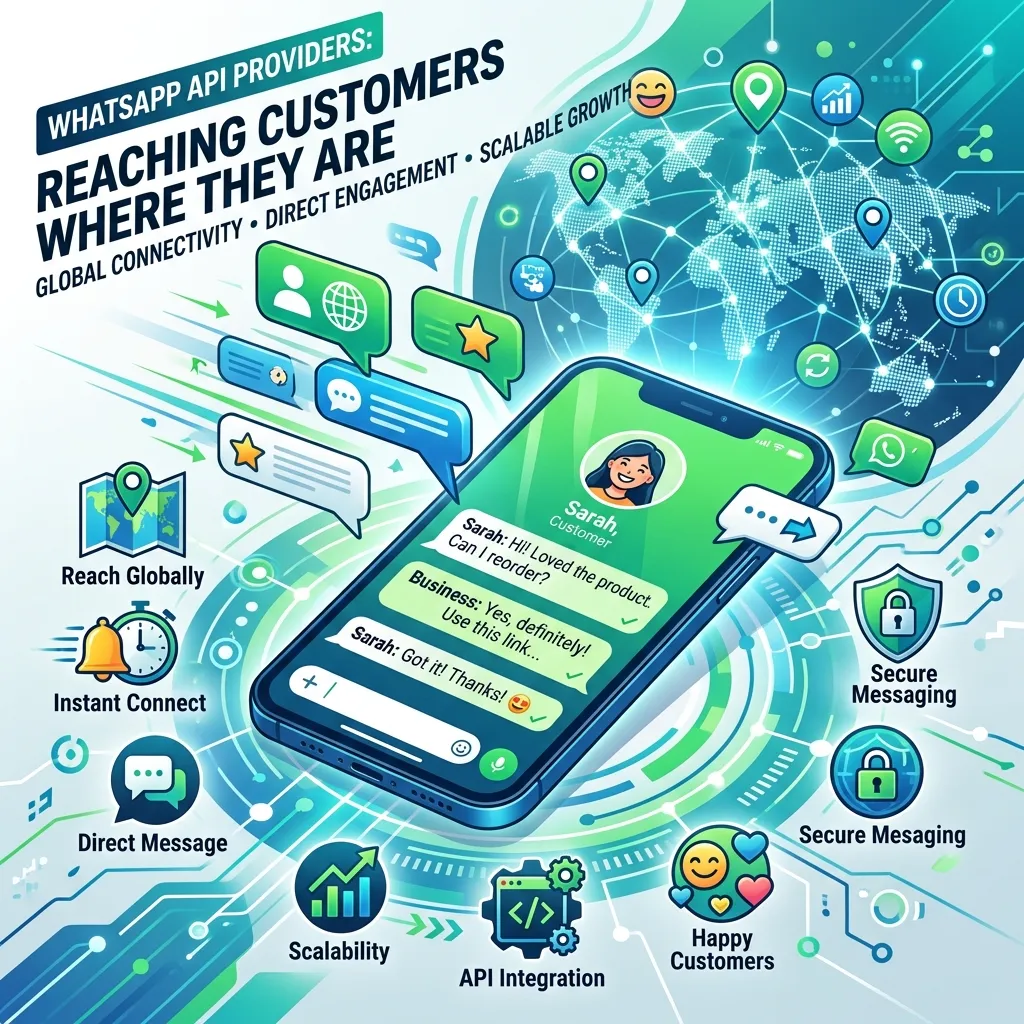
WhatsApp has over 2 billion users globally, and businesses can now reach them through the WhatsApp Business API. To use it, businesses must go through an official WhatsApp Business Solution Provider (BSP). Several communication API platforms have earned BSP status.
MessageBird (now Bird)
MessageBird—recently rebranded as Bird—is a prominent WhatsApp API provider that also covers SMS, email, and voice. Its Flow Builder tool allows non-technical users to build automated messaging workflows without writing code, which lowers the barrier to entry for marketing and operations teams.
Best for: Businesses that want WhatsApp and SMS under one platform, with automation capabilities that don’t require deep technical expertise.
Wati
Wati (WhatsApp Team Inbox) is built specifically for businesses that want to scale WhatsApp communication. It includes shared team inboxes, chatbot builders, broadcast messaging, and CRM integrations. Wati targets small and medium-sized businesses more than the enterprise segment, making it more accessible in terms of pricing and onboarding.
Best for: SMBs that want a WhatsApp-first messaging platform with collaborative inbox features.
Gupshup
Gupshup is a cloud messaging service provider based in India with strong traction across South and Southeast Asia. It supports WhatsApp, SMS, RCS, and more than 30 other messaging channels. Gupshup also offers a conversational AI layer on top of its messaging APIs, allowing businesses to deploy chatbots across channels.
Best for: Businesses targeting markets in Asia, or those that want to combine WhatsApp API access with conversational AI capabilities.
Real-Time Messaging API Providers for Transactional Use Cases
Some business messaging needs are less about marketing and more about speed. Transactional messages—authentication codes, fraud alerts, shipping notifications—need to arrive within seconds. Real-time messaging API providers optimize for exactly that.
Plivo
Plivo is a communication API platform known for competitive pricing and reliable delivery speeds. It covers SMS and voice, with particular strength in transactional messaging use cases like OTP delivery and two-factor authentication. Plivo often undercuts Twilio on price while maintaining solid uptime and delivery rates.
Best for: Businesses with high-volume transactional SMS needs that want a cost-effective Twilio alternative.
Nexmo (now Vonage API Platform)
Following Vonage’s acquisition of Nexmo, the Nexmo API platform lives on as part of Vonage’s developer ecosystem. Its Verify API—designed specifically for OTP and two-factor authentication—is one of the most widely used programmable messaging APIs for authentication workflows.
Best for: Developers building authentication flows who want a battle-tested OTP API with global reach.
Omnichannel Messaging Providers: Managing Every Channel in One Place
Customer communication has fragmented across channels. A customer might prefer SMS one day and WhatsApp the next. Omnichannel messaging providers let businesses manage all of these channels from a single platform, ensuring consistency across touchpoints.
Twilio Flex
Twilio Flex extends Twilio’s core messaging API into a full cloud contact center. It supports voice, SMS, WhatsApp, chat, and email—all within a programmable interface that businesses can customize to fit their workflows.
Best for: Companies that want to build a customized, omnichannel contact center on top of an existing Twilio relationship.
Zendesk (with messaging)
Zendesk integrates messaging natively into its customer support platform. Businesses can manage SMS, WhatsApp, and social messaging conversations alongside traditional email tickets—without switching between tools.
Best for: Customer support teams already using Zendesk that want to add messaging channels without adopting a new platform.
How to Choose the Right Messaging API Provider for Your Business
With so many options, the decision comes down to a few core questions:
- What channels do you need? If SMS is your primary channel, a specialist like Plivo or Sinch may be sufficient. If you need WhatsApp, email, and SMS under one roof, look at Infobip or Sinch.
- What’s your monthly message volume? High-volume bulk SMS senders should compare per-message pricing carefully. Providers like Plivo and Bandwidth often offer better rates at scale than Twilio.
- How much technical resource do you have? Some platforms, like MessageBird’s Flow Builder or Wati, are designed for non-developers. Others, like Twilio and Bandwidth, are built code-first.
- Where are your customers located? Regional coverage varies significantly. Gupshup dominates in South Asia; Vonage is strongest in Europe; Infobip has the broadest global carrier network overall.
- What compliance requirements apply to your business? Healthcare and financial services companies must pay close attention to HIPAA, GDPR, and TCPA compliance. Enterprise messaging solutions like Infobip and Bandwidth provide more comprehensive compliance tooling.The Right Messaging API Makes the Difference
Every business messaging conversation starts with infrastructure. The right communication API platform determines whether your messages arrive instantly or get dropped, whether your developers spend hours debugging integrations or ship features quickly, and whether your costs scale with you or spiral out of control.
There’s no universal best choice. Twilio wins on flexibility and documentation. Infobip wins on global coverage and enterprise features. Plivo wins on pricing for high-volume transactional messaging. The platform that fits your business is the one that aligns with your channels, your team’s technical capabilities, and your growth trajectory.
Start by identifying your primary use case—transactional, promotional, or conversational—and let that guide your shortlist. Most platforms offer free trials or developer sandboxes, so testing before committing is always worthwhile.
Frequently Asked Questions
What is the difference between an SMS API and a messaging API?
An SMS API handles specifically SMS and MMS messaging. A messaging API is a broader term that may include SMS, WhatsApp, RCS, push notifications, and other channels. Most modern communication API platforms offer multiple channels through a single API endpoint.
Which messaging API provider is best for small businesses?
Wati and MessageBird (Bird) are strong options for small businesses due to their lower entry pricing, user-friendly interfaces, and WhatsApp focus. Plivo is another good choice for small businesses that primarily need SMS at competitive rates.
How much does a messaging API cost?
Pricing varies by provider and channel. SMS via Twilio costs approximately $0.0079 per outbound message in the US. Plivo and Sinch often offer lower per-message rates. WhatsApp Business API pricing is conversation-based and varies by region. Most providers publish per-message pricing on their websites.
Do messaging API providers support two-way messaging?
Yes. Most leading SMS API providers, including Twilio, Vonage, Sinch, and Plivo, support two-way messaging, which allows businesses to send and receive messages in the same thread.
What is a bulk SMS API service?
A bulk SMS API service allows businesses to send large volumes of SMS messages simultaneously—typically for marketing campaigns, alerts, or notifications. Providers like Sinch, Infobip, and Gupshup specialize in high-throughput bulk messaging with delivery reporting and analytics.
Is WhatsApp API free for businesses?
The WhatsApp Business App is free, but the WhatsApp Business API—used by businesses at scale—is not. Pricing is conversation-based and charged per 24-hour conversation window. Rates vary by country and conversation type (marketing, utility, authentication, or service).
