

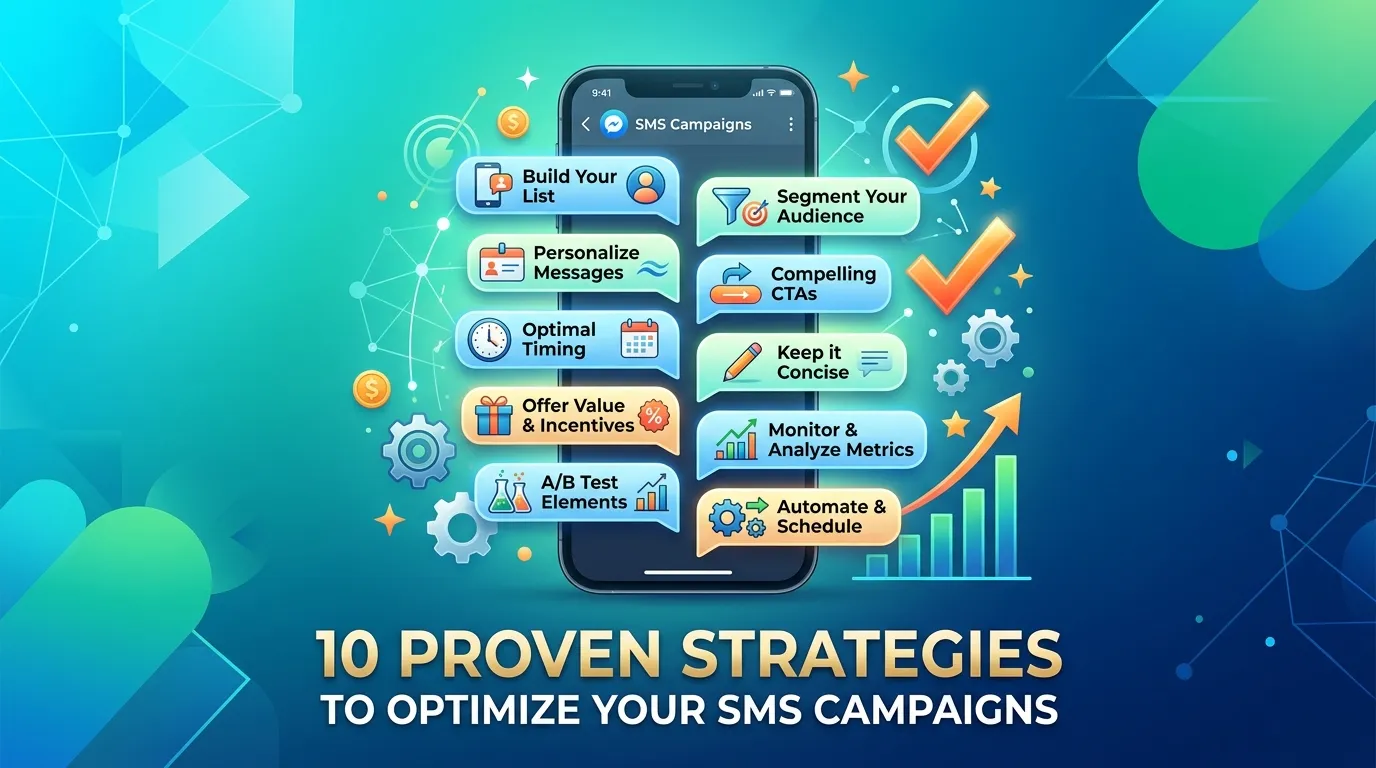
SMS campaigns optimization helps businesses improve the performance of their text message marketing by refining audience segmentation, personalization, automation, message timing, and analytics. This guide explains proven strategies to boost open rates, click-through rates, conversions, and ROI while reducing unsubscribe rates through data-driven SMS marketing.
SMS marketing remains one of the highest-performing channels available to marketers. According to SimpleTexting (2023), SMS messages have an open rate of 98%—compared to roughly 20% for email. Yet most brands still treat SMS as an afterthought, sending generic blasts to their entire list and wondering why conversions stall.
The gap between a good SMS program and a great one comes down to optimization. How well you know your audience, how precisely you time your messages, and how effectively you use automation all determine whether your campaigns drive revenue or drive unsubscribes.
This guide breaks down everything you need to build, measure, and refine an SMS strategy that actually performs—from bulk SMS campaign structure to click-through rate optimization and beyond.
What Makes a Bulk SMS Campaign Strategy Effective?
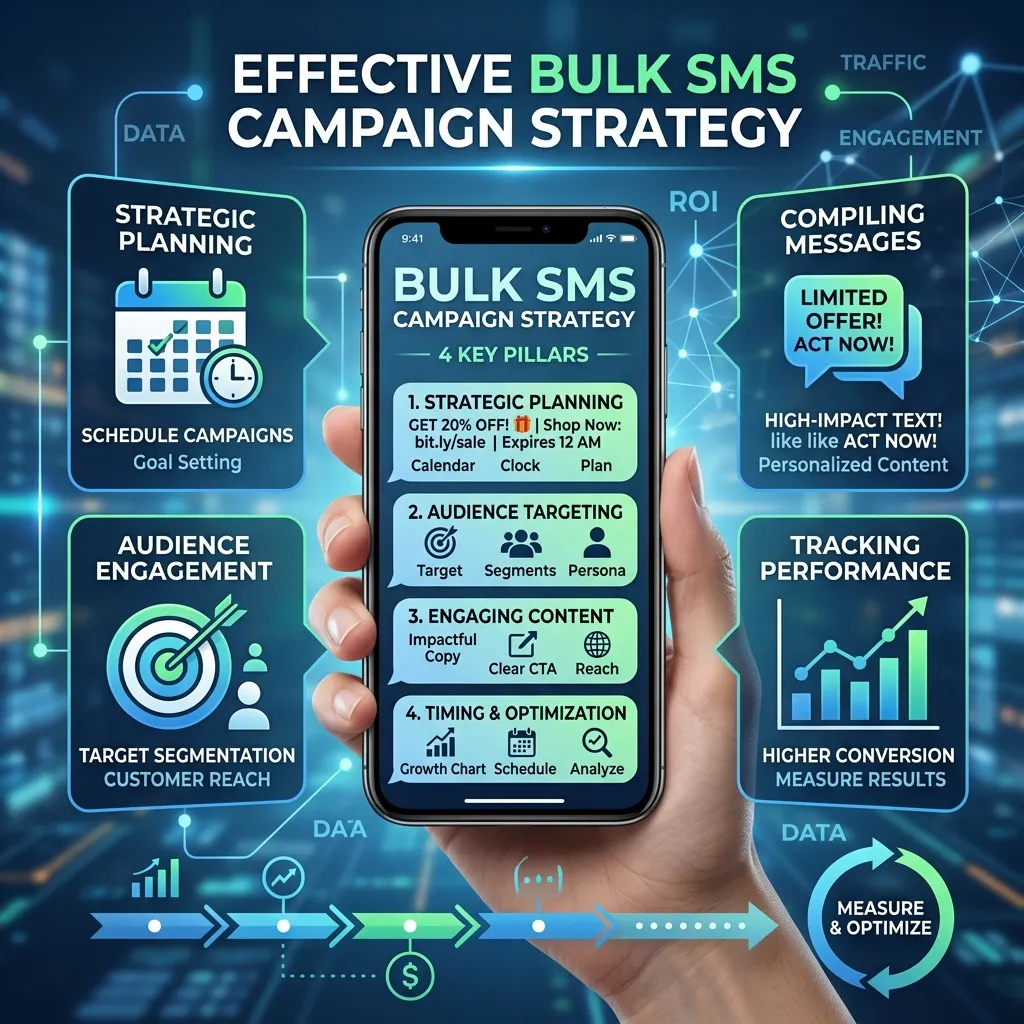
A bulk SMS campaign strategy is only as strong as its foundation. Before worrying about copy or timing, you need to answer three questions: Who are you sending to? What action do you want them to take? How will you measure success?
The biggest mistake brands make is conflating reach with relevance. Sending to your entire subscriber list might feel efficient, but irrelevant messages erode trust fast. Subscribers who feel bombarded with content that doesn’t apply to them opt out—and once they’re gone, they rarely come back.
An effective bulk SMS strategy starts with a clean, permission-based list. Every contact should have explicitly opted in, and your list should be regularly scrubbed to remove inactive or invalid numbers. From there, your strategy should define clear campaign objectives—whether that’s driving traffic to a landing page, promoting a limited-time offer, or recovering abandoned carts.
How to Set SMS Campaigns Goals That Drive Results
Set goals at two levels: business outcomes and SMS-specific metrics. Business outcomes might include revenue generated or leads captured. SMS-specific metrics—open rate, click-through rate (CTR), conversion rate, and opt-out rate—tell you how well your messages are performing at each stage of the funnel.
A useful benchmark: according to Klaviyo (2023), the average SMS click-through rate across industries sits between 8% and 15%. If your campaigns are falling below this range, it’s a signal to revisit your targeting, messaging, or offer.
How Does SMS Audience Segmentation Improve Campaign Performance?
SMS audience segmentation is the practice of dividing your subscriber list into smaller groups based on shared characteristics—purchase history, geographic location, browsing behavior, loyalty tier, or engagement level, for example.
Segmented campaigns consistently outperform unsegmented ones. According to Mailchimp (2021), segmented campaigns see 14.31% higher open rates and 100.95% higher click-through rates than non-segmented sends. While that data is from email, the principle applies directly to SMS: relevance drives engagement.
Useful segmentation models for SMS include:
- Behavioral segmentation: Grouping contacts by actions they’ve taken, such as past purchases or website visits
- Demographic segmentation: Dividing by age, location, or gender where relevant to your offer
- Engagement-based segmentation: Separating active subscribers from lapsed ones to tailor win-back campaigns
- Lifecycle stage: Differentiating between new subscribers, repeat customers, and VIP buyers
Start with two or three meaningful segments rather than over-complicating your list structure. As your program matures and your data improves, you can layer in more granular targeting.
Why Do Personalized SMS Campaigns Convert Better?
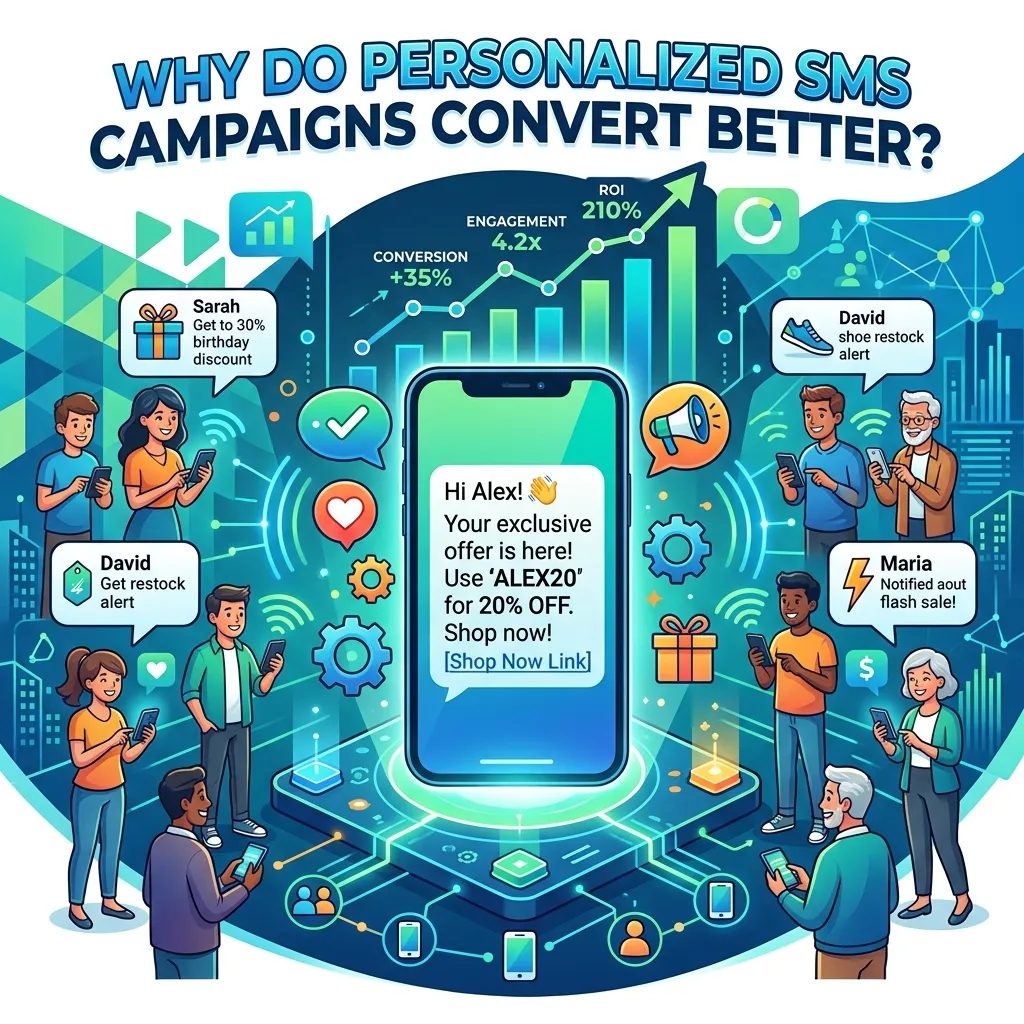
Personalized SMS campaigns go beyond inserting a first name into a message—though that’s a solid starting point. True personalization means delivering content that reflects where someone is in their customer journey, what they’ve purchased before, and what they’re most likely to want next.
Consider two versions of the same abandoned cart message:
- Generic: “You left something behind! Complete your purchase now.”
- Personalized: “Hey Sarah, your black leather tote is almost gone. Grab it before it sells out → [link]”
The second version acknowledges a specific product, creates urgency tied to real inventory, and uses the customer’s name. That specificity builds trust and makes the message feel less like a broadcast and more like a helpful nudge.
Dynamic fields—automatically populated using CRM or e-commerce data—make personalization scalable. Most enterprise SMS platforms support merge tags for first name, last purchase date, loyalty points balance, and more.
What Personalization Tactics Have the Highest Impact on SMS Conversions?
The highest-impact personalization tactics for SMS campaigns include:
- Product-specific messaging based on browsing or purchase history
- Location-based offers, such as promotions tied to a nearby store
- Birthday and anniversary triggers with exclusive discounts
- Loyalty milestone notifications (e.g., “You’re 50 points away from a free gift”)
- Replenishment reminders for consumable products
Each of these tactics requires clean, connected data. If your SMS platform isn’t integrated with your e-commerce platform or CRM, closing that gap is one of the highest-leverage investments you can make.
How Can SMS Automation Workflows Save Time and Increase Revenue?
SMS automation workflows allow you to send the right message at the right moment without manual intervention. Rather than scheduling individual campaigns, you build trigger-based sequences that activate based on customer behavior or predefined time intervals.
Common high-performing SMS automation workflows include:
- Welcome series: A two- to three-message sequence sent after a new subscriber opts in, introducing your brand and offering an incentive to make a first purchase
- Abandoned cart recovery: A reminder sent one to two hours after a customer leaves items in their cart, often with a time-sensitive discount
- Post-purchase follow-up: A message sent two to five days after delivery, requesting a review or offering a related product recommendation
- Win-back campaigns: A re-engagement sequence targeting subscribers who haven’t opened or clicked in 60 to 90 days
- Back-in-stock alerts: Triggered notifications when a previously sold-out item a customer showed interest in becomes available
According to Attentive (2023), abandoned cart SMS flows generate some of the highest ROI of any automated marketing sequence, with conversion rates up to 20% in certain retail verticals.
What SMS Marketing Best Practices Should Every Brand Follow?
Effective SMS marketing isn’t just about strategy—it’s also about execution. These best practices apply regardless of your industry or list size:
Keep messages short and direct. The recommended length for SMS campaigns is 160 characters or fewer. If your message runs longer, most platforms will split it into two messages, which can disrupt the reading experience and increase costs. Lead with the value, follow with the CTA.
Send at the right time. Research from EZTexting (2022) suggests that SMS messages sent between 10 a.m. and 12 p.m., or between 5 p.m. and 9 p.m. local time, consistently generate higher engagement. Avoid sending before 9 a.m. or after 9 p.m. to stay within TCPA compliance guidelines and respect your subscribers’ time.
Include a clear call to action. Every SMS should tell the recipient exactly what to do next. “Shop now,” “Claim your offer,” and “Reply YES to confirm” are all direct, unambiguous CTAs. Avoid vague instructions like “click here” without context.
Always provide an opt-out option. In the United States, the Telephone Consumer Protection Act (TCPA) requires that subscribers can easily opt out of SMS communications. Including “Reply STOP to unsubscribe” in your messages is both a legal requirement and a best practice that builds subscriber trust.
Test before you send. Always send a test message to yourself and a colleague before launching a campaign. Check that links work, dynamic fields are populating correctly, and the message renders well on both iOS and Android.
How Do You Improve SMS Click-Through Rate Optimization?
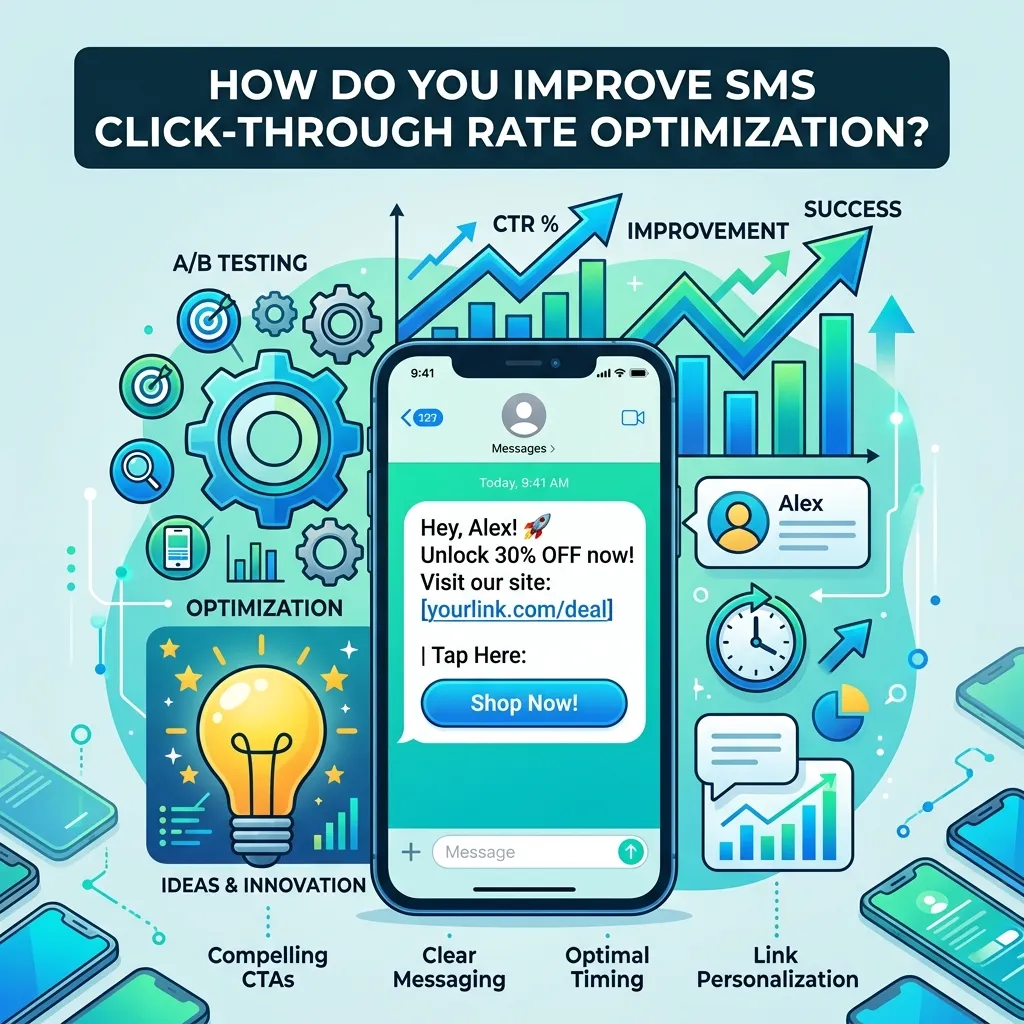
SMS click-through rate optimization focuses on increasing the percentage of recipients who tap the link in your message. CTR is one of the clearest indicators of message relevance—if subscribers aren’t clicking, the offer, the copy, or the timing isn’t landing.
Tactics that reliably improve SMS CTR include:
- Using shortened, branded URLs: Long URLs look spammy and eat into your character count. Branded short links (e.g., brand.co/offer) build trust and are more likely to be clicked.
- Creating genuine urgency: Countdown timers and specific deadlines (“Ends tonight at midnight”) outperform vague urgency (“Don’t miss out!”). Specificity makes the urgency feel real.
- A/B testing your CTA copy: Small wording changes can produce significant CTR differences. Test “Shop the sale” against “Claim your 20% off” to find what resonates with your audience.
- Matching the message to the landing page: If your SMS promotes a specific product, the link should go directly to that product page—not your homepage. Every extra click a subscriber has to make reduces conversion probability.
How Should You Use SMS Marketing Analytics to Improve Future Campaigns?
SMS marketing analytics give you the data you need to understand what’s working and where to improve. The core metrics to track for every campaign include:
- Delivery rate: The percentage of messages successfully delivered. Rates below 95% may indicate list quality issues.
- Open rate: For SMS, this is typically inferred from link clicks or reply rates, since message delivery doesn’t confirm a message was read.
- Click-through rate (CTR): Clicks divided by messages delivered. Use UTM parameters on all links to track SMS-driven traffic accurately in Google Analytics or your analytics platform.
- Conversion rate: The percentage of recipients who completed the desired action (purchase, sign-up, booking) after clicking.
- Opt-out rate: High opt-out rates (above 0.5% per campaign) signal that your messaging frequency, relevance, or targeting needs adjustment.
Review these metrics after every campaign send. Over time, patterns emerge—certain segments respond better to specific offer types, certain send times consistently outperform others, and certain message formats drive higher CTR. Building these insights into your standard process turns each campaign into a data point that improves the next one.
How Often Should You Review SMS Campaigns Performance Data?
Review campaign-level data within 24 to 48 hours of each send, when most engagement activity has already occurred. Conduct a deeper performance review monthly to identify trends across segments, offer types, and send cadences. Quarterly reviews should inform broader strategy decisions, such as whether to expand automation workflows or reallocate budget between channels.
Build the SMS Program Your Subscribers Actually Want
The brands winning at SMS aren’t sending the most messages—they’re sending the most relevant ones. Segmentation, personalization, automation, and analytics aren’t separate tactics; they’re interconnected levers that, when pulled together, compound into significantly better performance.
Start by auditing your current program against the best practices in this guide. Are your segments meaningful? Are your automations triggered by real behavior? Are you measuring CTR and conversion at the campaign level? Identify the one or two areas with the biggest gap, and focus your optimization efforts there first.
SMS has a short feedback loop. Small improvements to targeting or copy can show up in your metrics within days. That speed makes it one of the most rewarding channels to optimize—and one of the most powerful when you get it right.
Frequently Asked Questions About
What is SMS campaign optimization?
SMS campaigns optimization is the process of improving the performance of text message marketing campaigns by refining audience segmentation, message personalization, send timing, automation workflows, and analytics review. The goal is to increase key metrics like click-through rate, conversion rate, and ROI while reducing opt-outs.
What is a good click-through rate for an SMS campaigns?
According to Klaviyo (2023), the average SMS click-through rate across industries falls between 8% and 15%. Highly targeted, personalized campaigns with strong offers can exceed this range, while untargeted bulk sends often fall below it.
How often should I send SMS marketing messages?
Most brands send SMS campaigns two to four times per month. Sending more frequently than this risks higher opt-out rates unless every message delivers clear, relevant value. Automated trigger-based messages (such as abandoned cart or post-purchase follow-ups) are separate from broadcast campaigns and can be sent more frequently without fatiguing subscribers.
What is the best time to send an SMS marketing campaign?
Research from EZTexting (2022) identifies 10 a.m. to 12 p.m. and 5 p.m. to 9 p.m. local time as the highest-engagement windows for SMS campaigns. Avoid sending before 9 a.m. or after 9 p.m. to comply with TCPA guidelines and respect subscriber preferences.
How does SMS automation improve conversion rates?
SMS automation delivers messages at the moment they are most relevant to the recipient—immediately after a cart abandonment, following a purchase, or on a subscriber’s birthday. This timing relevance, combined with personalized content, means automated SMS workflows consistently outperform manually scheduled broadcast campaigns in conversion rate.
What is the difference between SMS segmentation and SMS personalization?
SMS segmentation divides your subscriber list into groups based on shared characteristics (e.g., purchase history, location, or engagement level). SMS personalization tailors the content of individual messages within those segments using dynamic data fields, such as a recipient’s first name, last purchased product, or loyalty points balance. Both strategies work best when used together.
